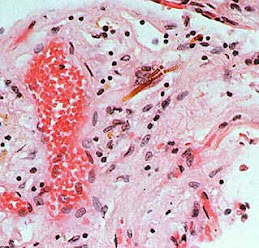
Largest-Yet Mesothelioma Study Shows Survival Benefit with New Drug
Researchers with the largest phase III trial to date for mesothelioma, an aggressive cancer affecting the lining of the lung, reported results showing that patients on a new chemotherapy drug regimen live longer and have less pain than those on an older drug. The findings were announced at the annual meeting of the American Society of Clinical Oncology meeting in Orlando, Fla., on May 20, 2002. (NOTE: The final data were subsequently published in the July 15, 2003, issue of the Journal of Clinical Oncology; see the journal abstract).
Pemetrexed (brand name Alimta™) is a novel antifolate, a class of drugs that targets the folic acid metabolic pathway, which effects availability of certain B complex vitamins. The results of the trial show that tumors shrank in 41 percent of patients on pemetrexed in combination with a more commonly used chemotherapy agent called cisplatin. Only 17 percent of patients receiving cisplatin alone experienced tumor shrinkage. Additionally, those on the pemetrexed combination lived nearly three months longer than those on cisplatin alone.
According to lead author, Nicholas J. Vogelzang, M.D., University of Chicago Cancer Research Center, "This is the largest clinical trial ever conducted in this disease and the 25 to 30 percent improvement in survival for patients on the combination therapy is the first time anyone has documented a significant improvement in patients treated for mesothelioma."
Malignant pleural mesothelioma is associated with a history of asbestos exposure in about 70 to 80 percent of all cases and there is no approved or very effective chemotherapy for the disease. Researchers hypothesized that pemetrexed might prove effective in treating this disease because it targets key enzymes (molecules that speed up chemical reactions in the body) thought to play a role in allowing the rapid growth of this tumor.
Early phase I trial results in 11 patients tested with pemetrexed and cisplatin were promising and a definitive randomized phase III trial was developed. Since there are no established therapies for this condition, a standard chemotherapy agent called cisplatin that has shown efficacy in treating other diseases, was used as the control group. The phase III study initially planned to enroll 456 patients from April 1999 to March 2001. However, after enrolling 150 patients, a high rate of severe toxicity and death was associated with the pemetrexed and cisplatin arm of the trial. Elevated levels of homocysteine, a chemical byproduct that results when proteins are broken down in the blood, were found, which provided a basis for redesign of the trial to reduce the dangerous drug side effects.
Two hundred and eighty patients were enrolled to the revised protocol. Using a strategy to reduce drug side effects that has been successful in the past, this new protocol added folic acid to the regimen because pemetrexed as an antifolate agent reduces levels of this important vitamin. Folic acid was given prior to and during the trial, and vitamin B12 was given only during the trial. Both vitamins should boost folic acid levels, reduce homocysteine formation, and hence reduce toxicity to pemetrexed. "We now have a significantly less toxic regimen than the one we started with," said Vogelzang.
Because of the presumed importance of the vitamins to the study, the researchers examined not only the combination therapy versus the single drug therapy, but also looked at the results of patients on the vitamin supplements versus those early enrollees who had not initially received vitamins.
Standard treatment for malignant mesothelioma has been surgery. Surgical treatment rarely results in cure and long-term survival is unusual. Use of radiation therapy and/or chemotherapy following surgery has not improved survival for patients but radiation treatments may alleviate some pain associated with the disease