Cognitive Information About Mesothelioma And Mesothelium
Cognitive Information About Mesothelioma And Mesothelium
By
sixerra741
Mesothelioma is a sort of cancer when malignant tumor is found in the safety saccule that covers the majority of the body's internal organs. Doctors identify is as mesothelium. Nevertheless, they also accuse asbestos as the principal cause of this sort of cancer if a person inhales these small parts. This disease is infrequent, but grave and in the majority of cases has a lethal outcome.
As it's already clear the name mesothelioma comes from mesothelium, a protective covering that coats and shields most of the internal organs of the body such as the lungs and heart. The diagnose of mesothelioma is made if cells of the mesothelium become damaged by the swelling. Moreover, they may attack and destroy nearby tissues.
Mesothelium itself is composed of two layers of cells: the first layer outright covers the organ; the other constitutes a sac around it. The main designation of mesothelium is to produce a lubricating fluid that is released amidst these two layers. This allows such moving organs like beating heart and the expansible lungs to slide without any difficulty against adjacent structures.
The name mesothelium is rather seldom used in relation to cancer processes. The reason for this is that coverings shielding different organs are named in different ways. This way, saccule of the heart is pericardium, saccule of the lungs and chest cavity is usually called pleura, coat of the stomach is often called peritoneum. The most widespread location of mesothelioma swelling is pleura. Take into consideration that reproductive organs of males and females are also coated with mesothelium but the cases of mesothelioma cancer in these areas are very rare.
The mesothelioma swelling has 2 forms: a benign and a malignant sort of the cancer. The benign form is not leading to fatality. A diagnosis of malignant Mesothelioma is often fatal, but not all the time. A Mesothelioma diagnosis was a death sentence about 20 years ago. This is no longer the case. If you, a friend or a loved one is diagnosed with it, be positive and persistent in seeking cure.
The writer of the article is an expert in the questions of medical investigations, and, especially, mesothelioma. More precise info on mesothelioma medical treatment can be found at his internet site.
Article Source: Articles island - Free article submission and free reprint articles
Showing posts with label asbestos-induced lung cancer. Show all posts
Showing posts with label asbestos-induced lung cancer. Show all posts
Friday, July 29, 2011

Sunday, May 15, 2011
Largest-Yet Mesothelioma Study Shows Survival Benefit with New Drug
Largest-Yet Mesothelioma Study Shows Survival Benefit with New Drug
Researchers with the largest phase III trial to date for mesothelioma, an aggressive cancer affecting the lining of the lung, reported results showing that patients on a new chemotherapy drug regimen live longer and have less pain than those on an older drug. The findings were announced at the annual meeting of the American Society of Clinical Oncology meeting in Orlando, Fla., on May 20, 2002. (NOTE: The final data were subsequently published in the July 15, 2003, issue of the Journal of Clinical Oncology; see the journal abstract).
Pemetrexed (brand name Alimta™) is a novel antifolate, a class of drugs that targets the folic acid metabolic pathway, which effects availability of certain B complex vitamins. The results of the trial show that tumors shrank in 41 percent of patients on pemetrexed in combination with a more commonly used chemotherapy agent called cisplatin. Only 17 percent of patients receiving cisplatin alone experienced tumor shrinkage. Additionally, those on the pemetrexed combination lived nearly three months longer than those on cisplatin alone.
According to lead author, Nicholas J. Vogelzang, M.D., University of Chicago Cancer Research Center, "This is the largest clinical trial ever conducted in this disease and the 25 to 30 percent improvement in survival for patients on the combination therapy is the first time anyone has documented a significant improvement in patients treated for mesothelioma."
Malignant pleural mesothelioma is associated with a history of asbestos exposure in about 70 to 80 percent of all cases and there is no approved or very effective chemotherapy for the disease. Researchers hypothesized that pemetrexed might prove effective in treating this disease because it targets key enzymes (molecules that speed up chemical reactions in the body) thought to play a role in allowing the rapid growth of this tumor.
Early phase I trial results in 11 patients tested with pemetrexed and cisplatin were promising and a definitive randomized phase III trial was developed. Since there are no established therapies for this condition, a standard chemotherapy agent called cisplatin that has shown efficacy in treating other diseases, was used as the control group. The phase III study initially planned to enroll 456 patients from April 1999 to March 2001. However, after enrolling 150 patients, a high rate of severe toxicity and death was associated with the pemetrexed and cisplatin arm of the trial. Elevated levels of homocysteine, a chemical byproduct that results when proteins are broken down in the blood, were found, which provided a basis for redesign of the trial to reduce the dangerous drug side effects.
Two hundred and eighty patients were enrolled to the revised protocol. Using a strategy to reduce drug side effects that has been successful in the past, this new protocol added folic acid to the regimen because pemetrexed as an antifolate agent reduces levels of this important vitamin. Folic acid was given prior to and during the trial, and vitamin B12 was given only during the trial. Both vitamins should boost folic acid levels, reduce homocysteine formation, and hence reduce toxicity to pemetrexed. "We now have a significantly less toxic regimen than the one we started with," said Vogelzang.
Because of the presumed importance of the vitamins to the study, the researchers examined not only the combination therapy versus the single drug therapy, but also looked at the results of patients on the vitamin supplements versus those early enrollees who had not initially received vitamins.
Standard treatment for malignant mesothelioma has been surgery. Surgical treatment rarely results in cure and long-term survival is unusual. Use of radiation therapy and/or chemotherapy following surgery has not improved survival for patients but radiation treatments may alleviate some pain associated with the disease
Saturday, January 30, 2010
Asbestos-Induced Lung Cancer Responds to Eli Lilly Experimental Drug
Alimta News
Asbestos-Induced Lung Cancer Responds to Eli Lilly Experimental Drug
The Indianapolis Star
An experimental Eli Lilly and Co. drug lengthened the lives of patients with cancer of the lung lining that's mainly caused by asbestos. The study finding, released Monday, heartened cancer researchers because the deadly cancer has proven resistant to treatment and no drugs are approved in the United States to treat it. "This is an historic day. Patients and their families who deal with this disease now have a clear path forward," said Dr. Nicholas J. Vogelzang, director of the University of Chicago Cancer Research Center.
The dramatic results came in the largest-ever patient study for cancer of the lung lining, called pleural mesothelioma. The study of 456 patients showed that those given the Lilly drug Alimta, plus a commonly used chemotherapy drug and vitamins, lived for 13 months after diagnosis of the cancer. That compared to seven months for those who received only the standard chemotherapy cisplatin and vitamins. "That is a very, very striking difference for a disease considered hopeless," Vogelzang said. Patients taking Alimta during the yearlong study also suffered from less pain and had fewer breathing difficulties, said Dr. Paolo Paoletti, a Lilly researcher who is team leader for Alimta's development at Lilly's Indianapolis labs.
Alimta could be on the market next year. Lilly plans to file in 2003 for approval from the U.S. Food and Drug Administration to market Alimta for the lung cancer. Alimta is in the last of three phases of human testing for that cancer. Cancer of the lung lining is rare, diagnosed in only 2,500 Americans and 5,000 Europeans a year, but its prevalence is rising as more people are found to be exposed to the once commonly sold asbestos that causes the cancer. Most people die within nine months of diagnosis. Lilly also is testing Alimta on other cancers, including that of the pancreas, where Alimta shows early promise.
When Alimta was combined with the marketed Lilly drug Gemzar and given to patients with pancreatic cancer, a third of them were alive after one year, a new Lilly study shows. That compares to an 18 percent one-year survival rate generally among pancreatic cancer patients treated with Gemzar alone, Lilly said.
The molecule that is Alimta came to Lilly from a Princeton University researcher. It works like three or more cancer drugs in one, by targeting multiple enzymes that cancer cells need to take up folic acid and multiply.
Subscribe to:
Posts (Atom)
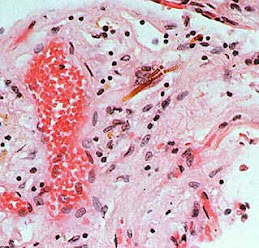
Lung Tissue With Asbestos Fibers